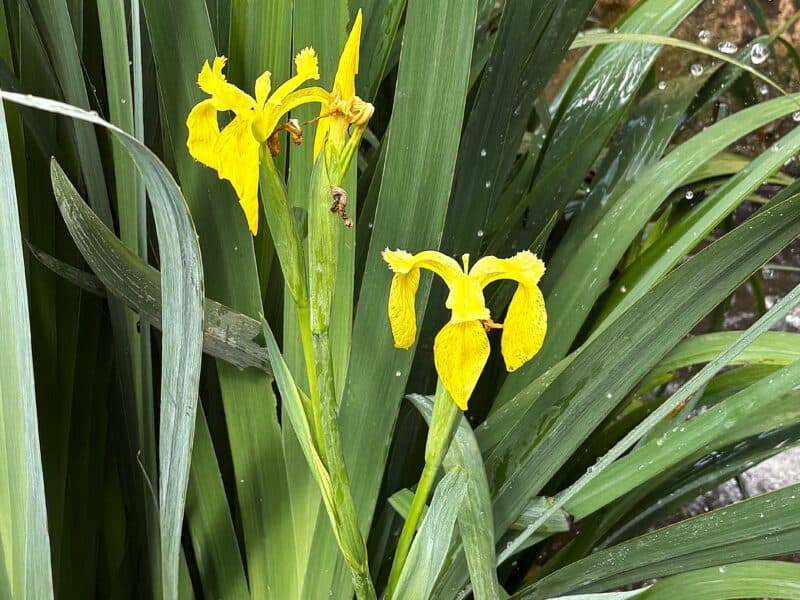
Meet the iris of the Bible, Iris pseudacorus, also known as yellow flag. I confess that in my years of reporting and recording, planting and proclaiming the plants of the Bible, I’ve ignored iris! Yet this water-loving plant, ready to bloom and thrive with “wet feet,” can fill a marshy spot or pond’s edge in your garden, and give us a Word to be refreshed in iris.
I will be as the dew to Israel; he shall blossom as the lily [iris], he shall strike root as the poplar… Hosea 14:5 RSV
Several Biblical botanists, most prominently Harold Moldenke,* conclude that this mention of lily, translated from the Hebrew word, shûwshan or sûsan, would have likely been yellow flag, the colorful, perennial flowers glad to grow where water is abundant.
Over the years, I have written that the Bible’s mention of “lilies”—from 1 Kings 7:12 to Song of Songs 6:2 to Luke 12:27, and similarly, Matthew 6:28—may not exclusively mean lily, Lilium candidum. It is a generic though joyful term for flowers growing in the countryside, from the root word for exult and rejoice; it likely refers more to a bold fanfare of color than a specific type of flower, inferred from the association with Solomon’s splendor:
Consider the lilies, how they grow: they neither labor nor spin; but I tell you, not even Solomon in all his glory clothed himself like one of these. Luke 12:27 NASB
Most researchers assign the crown anemone, Anemone coronaria, to the directive that Jesus sets forth: Ponder faithful spring bloomers and don’t worry! The Father is faithful and pleased to give all that we need from His vast Kingdom (Luke 12:32). You have heard me highlight crown anemones often, featuring these cheerful beauties in chapter 5 of My Father is the Gardener. However, I had forgotten that shûwshan can refer to more than one flower type: sorry to ignore you, iris!
Furthermore, the landscape in Hosea is pictured differently from the “flowers of the field” where Jesus spoke to His followers. Jesus was teaching on trusting the Father, whereas Hosea urged Israel to return to the Father.
Hosea’s Backstory
Most of the Words in the book of Hosea addressed the wayward, adulterous activity of Israel that led to their exile; God’s people had turned from Him, choosing to practice the ways of their godless neighbor-nations. This book is hardly happy reading. At a peak moment, Hosea reported:
A spirit of prostitution leads them astray; they are unfaithful to their God. They sacrifice on the mountaintops and burn offerings on the hills, under oak, poplar and terebinth, where the shade is pleasant. Hosea 4:13 NIV
Though the leafy forest offered shelter and refuge from intense spring and summer sunshine, the people were using the shade as a cover for shameful deeds, reiterating Adam and Eve’s hiding from the Lord under trees (Genesis 3:8). Once again, trees intended to be pleasing were tainted with turning away from God and His goodness, filling the forest with moral filth.
Refreshed in Iris
Thankfully, the final chapters in Hosea spoke to Israel’s restoration, confirming God’s faithfulness to His people, prophesying their return to Him. The poplar forest would be cleansed and flourish with colorful, water-thriving iris, foreshadowing the message of God’s flower-faithfulness that Jesus would later teach.
I will be as the dew to Israel; he shall blossom as the lily [iris], he shall strike root as the poplar… Hosea 14:5 RSV
Understanding the botanical layers in this verse is a bit tricky, as “liḇnê,” Hebrew word for poplar tree, has been traditionally read as “lᵊḇānôn,” assuming the conifer forests to the north in Lebanon, which are no doubt refreshing…yet I think the point of this redemptive proclamation is that the former detestable forest activities (Hosea 4:13) will be cleansed and the people revived, with a profusion of beautiful iris to declare it, hallelujah!
Modern opinion holds that the Authorized Version’s [KJV] translation of Hosea 14:5—“cast forth his roots as Lebanon”—is erroneous, the Hebrew word being “livnah” not “l’vanon”. MOFFATT[*] translates “and strike roots down like a poplar,” while GOODSPEED[*] version is: “ And his roots will spread like the poplar.” It is, of course, well known that poplar roots grow rapidly towards any water in the vicinity.
Harold and Alma Moldenke, “Populus alba,” Plants of the Bible, 1952, page 182
See this redemptive passage with the underlying current of Psalm 1—
Blessed is the one…whose delight is in the law of the Lord, and who meditates on his law day and night. That person is like a tree planted by streams of water, which yields its fruit in season and whose leaf does not wither—whatever they do prospers. Psalm 1:2-3 NIV
—which in turn overflows from the design of Eden.
And out of the ground the Lord God made to grow every tree that is pleasant to the sight and good for food…A river flowed out of Eden to water the garden Genesis 2:9-10 RSV
Redemption and reformation abound in this moment of botanic metaphor. May we enjoy a measure of this prophecy as we work and take care of our gardens, dear gardeners! Soak up more Words reflecting the nature of iris’ revival sign:
Return, Israel, to the Lord your God, For you have stumbled because of your wrongdoing. Take words with you and return to the Lord. Say to Him, “Take away all guilt And receive us graciously…” Hosea 14:1-2 NASB
Let my teaching drop down like rain, and let my sayings distill like dew, like raindrops on grass, like showers on green plants. Deuteronomy 32:2 EHV
The Lord says, “Then I will heal you of your faithlessness; my love will know no bounds, for my anger will be gone forever…” Hosea 14:4 NLT
You’ll be like a well-watered garden, a gurgling spring that never runs dry. Isaiah 58:11 The Message
Jesus stood up and shouted, “…Have faith in me, and you will have life-giving water flowing from deep inside you, just as the Scriptures say…” John 7:37-38 CEV
God made everything beautiful in itself and in its time Ecclesiastes 3:11 The Message
Growing Iris pseudacorus
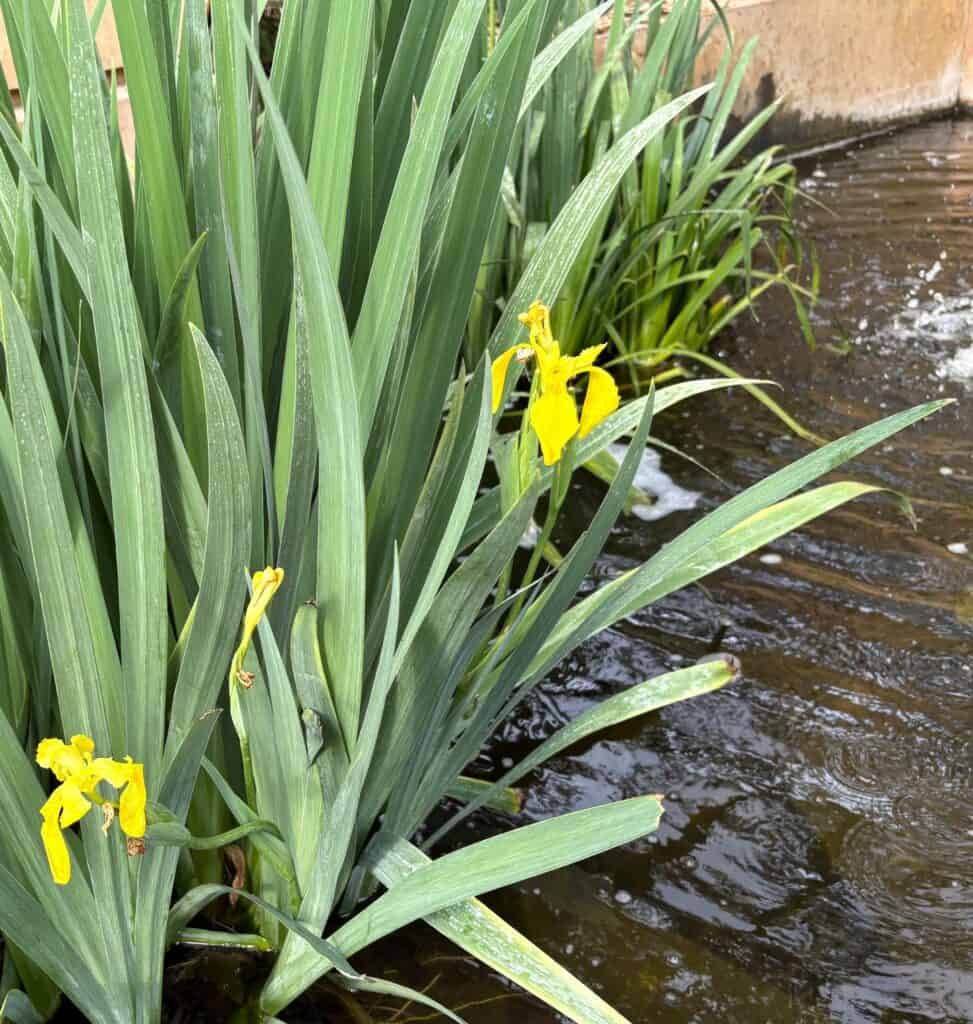
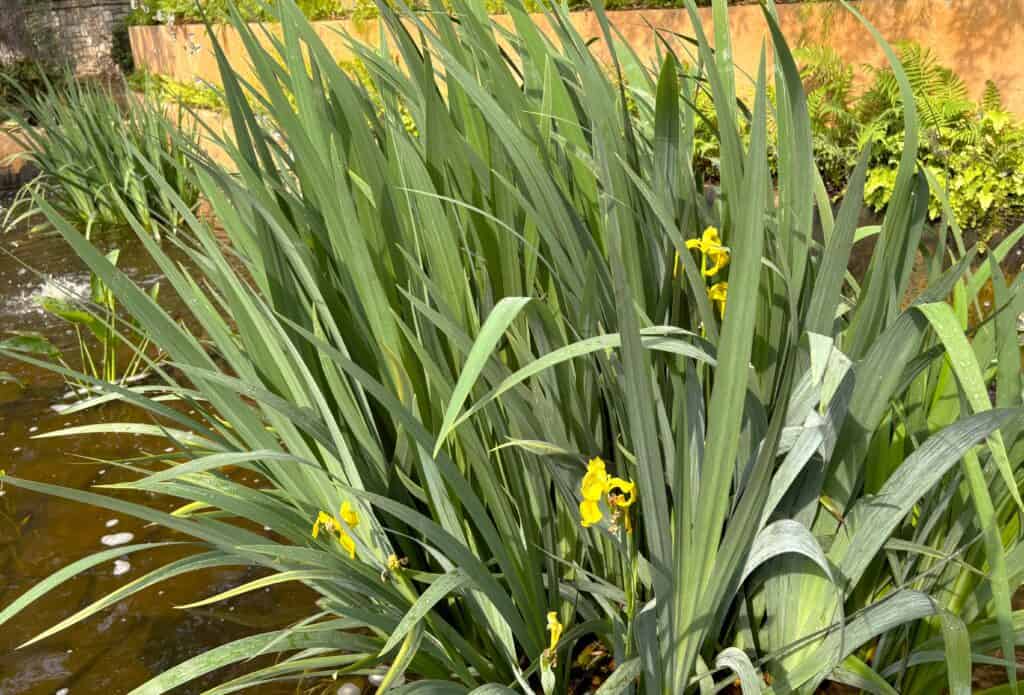
How does this “lily” blossom? True to its iris heritage, yellow flag, Iris pseudacorus, also called paleyellow iris or bog iris, blooms in late spring to early summer, sending up solitary, strong stems that yield 2 or 3 cascading blooms per stalk. Their vivid yellow color “flags” attention and adorns slender, sword-like leaves for an attractive water’s edge display. Yellow flag is a beardless iris. Scout them along your favorite waterway; yellow flag grows in nearby lakes, streams, and estuaries across most states in our nation.
So far, I have only made acquaintance with yellow flag at the San Antonio Botanical Garden, where I snapped these photos at Fountain of the Ferns. Yellow flag steals the show! Now I’m on the lookout for these beauties in waterways everywhere.
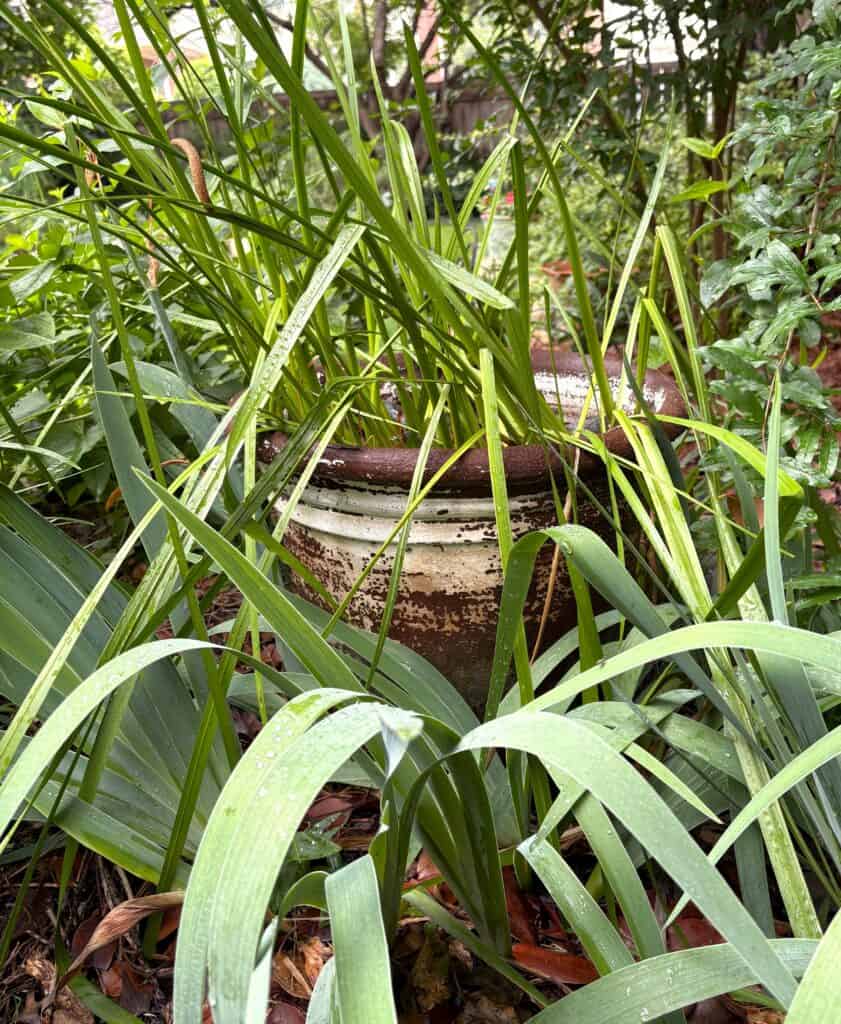
In the garden, plant yellow flag by rhizome, although by seed is also possible. Iris are relatively carefree, a gardener’s dream, happily if not aggressively growing with plentiful watering. They can thrive equally well in shallow, standing water or in soil with consistent moisture. Few pests trouble their growth. Tending to their assertive spread may be your biggest chore: NOTE! Many regions consider Iris pseudacorus to be invasive and restrict their planting.
Once their blooming period has passed, yellow flag continues to offer strong green foliage to keep the landscape looking upright and lively. In mild climates, they are nearly evergreen; pull away any marred or withering leaves to keep the perennial clumps looking their best.
U.S. Forestry Service cultural information for Iris pseudacorus
American Iris Society – Species Iris Pseudacorus
Missouri Botanical Garden warns against planting Iris Pseudacorus
Find more information on growing Iris Yellow Flag in the Plant Guide
Closing Prayer
O merciful Lord, You have caught my eye with a flower and drawn me to Your Words of refreshing promise and prophecy. You love me and will love me; You heal me and will heal me. You forgive my waywardness (and my forgetfulness!) and beckon me to return to You (Hosea 14:1-4). Thank You for welcoming me in Your dew-like Presence, a daily watering ready to refresh me and create around me a forested refuge and shelter. Thank you that I may hold onto Your promises for Israel as my own: I am glad to be grafted into this holy heritage (Romans 11:17-18) by way of Your Son, Jesus. I pray for this precious people, Israel, to whom You gave the Words of life (Deuteronomy 32:47), to return to You and carry on in keeping Your ways and walking with You (Hosea 14:9). Bless us all to be united and grounded in Your Word as we plant yellow flag and other bold-colored flowers in this season. O Lord, thank You that Your way is to water our souls always (Isaiah 55:1, Revelation 22:17). In Jesus Name, we pray, Amen.
About Joseph he said: “May the Lord bless his land with the precious dew from heaven above and with the deep waters that lie below…” Deuteronomy 33:13 NIV

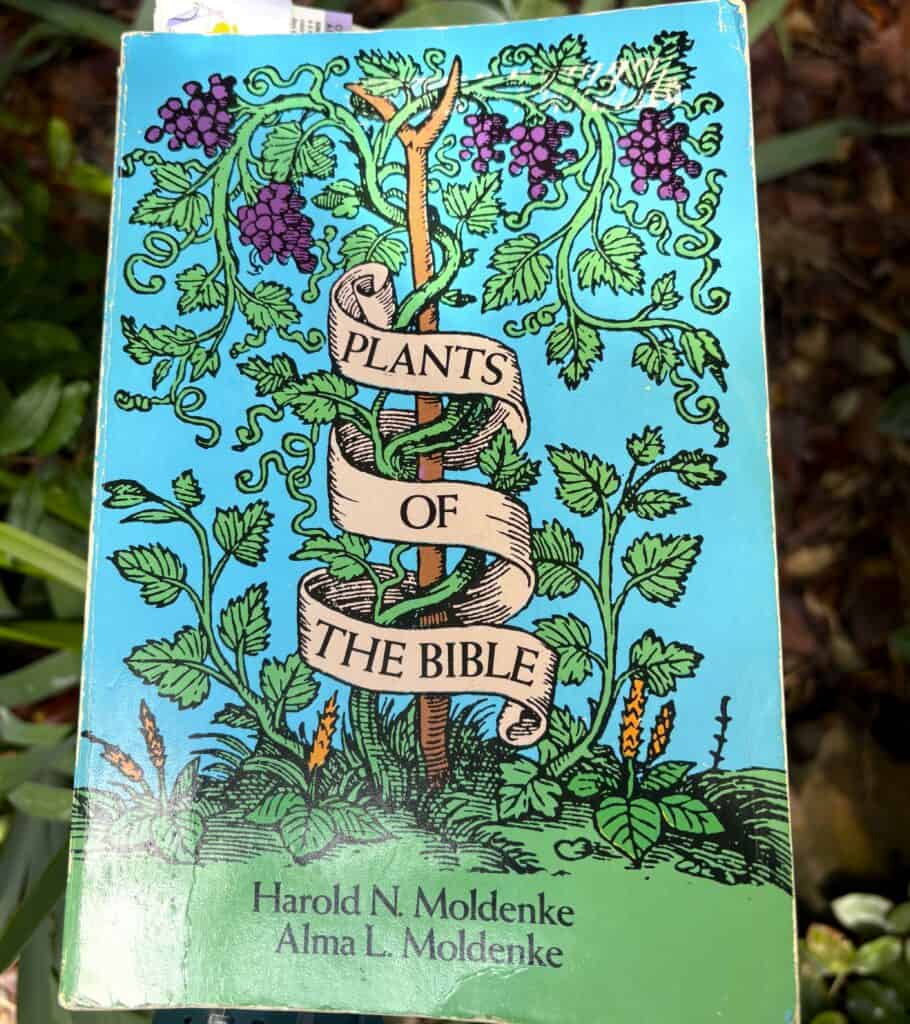
[*] From Harold N. and Alma L. Moldenke, Plants of the Bible (Waltham, Mass.: Chronica Botanica, 1952). MOFFATT refers to Moffatt, J., The Old Testament: a new translation. Volume II, Job-Malachi, [London: Hodder and Stoughton, 1924]. Available at Archive.org; GOODSPEED refers to Goodspeed, E.J., et al., “Complete Bible: an American translation. [Chicago: Univ. of Chicago Press, 1939]. Available at OpenLibrary.org. Many thanks to the marvelous, enduring research of this precious couple!
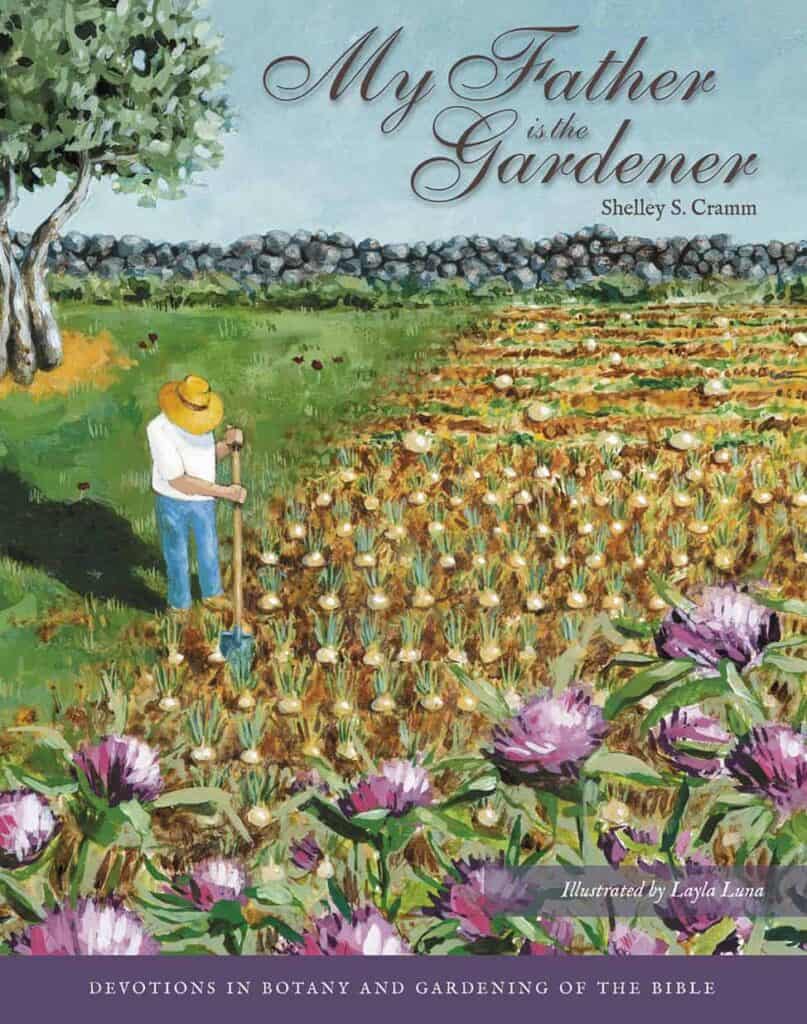
Do you enjoy connecting your garden work to God’s Word? My Father is the Gardener is a devotional book for you! Read more about crown anemone “lilies” featured in chapter 5

The Garden in Delight Plant Guide features lily, crown anemone, and more “flowers of the field” with growing information to start a Biblical flower garden. Just added: Iris Yellow Flag! Also find other water-loving, Biblical plants like papyrus and calamus

Are you a flower gardener? Take a look at this special series, Let Faith Flourish, from the Devotions Blog on “flowers of the field” and their cascading bloom in spring
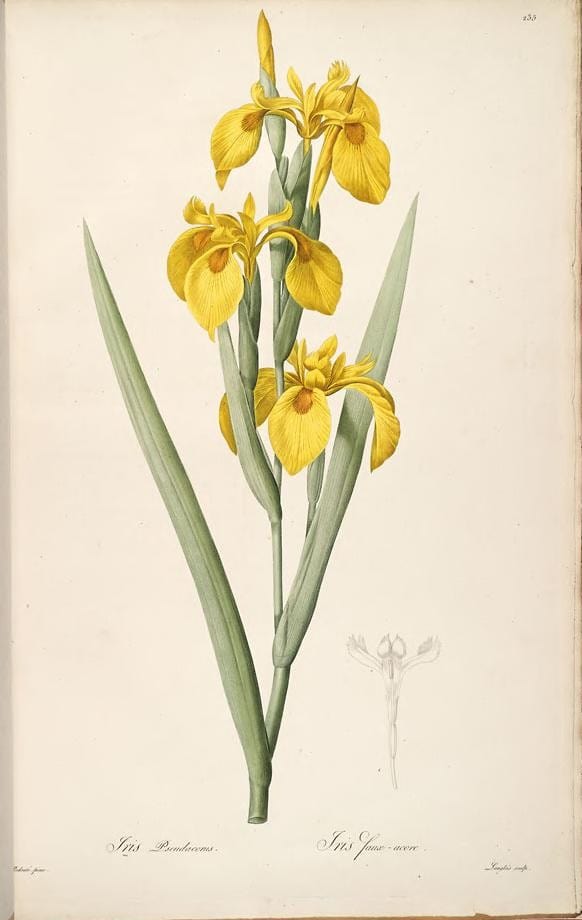
Photo Credits: Iris pseudacorus illustration from Redoute, Pierre Joseph. Liliacees. Available at Biodiversity Heritage Library – Les Lilicees; all other photography ©Shelley S. Cramm taken at San Antonio Botanical Garden: Iris yellow flag steal the show at John L. Santikos Fountain of the Ferns
CEV notes Scripture quotations taken from the Contemporary English Version Copyright © 1991, 1992, 1995 by American Bible Society, Used by Permission.
EHV notes Scripture quotations taken from The Holy Bible, Evangelical Heritage Version® , EHV®, © 2019 Wartburg Project, Inc. All rights reserved. Used by permission.
The Message denotes Scripture quotations taken from THE MESSAGE, copyright © 1993, 2002, 2018 by Eugene H. Peterson. Used by permission of NavPress. All rights reserved. Represented by Tyndale House Publishers, a Division of Tyndale House Ministries.
NASB denotes Scripture quotations taken from the NEW AMERICAN STANDARD BIBLE®, Copyright © 1960,1962,1963,1968,1971,1972,1973,1975,1977,1995 by The Lockman Foundation. Used by permission.
NIV denotes Scripture quotations taken from the Holy Bible, New International Version®, NIV®. Copyright © 1973, 1978, 1984, 2011 by Biblica, Inc.® Used by permission of Zondervan. All rights reserved worldwide. www.zondervan.com The “NIV” and “New International Version” are trademarks registered in the United States Patent and Trademark Office by Biblica, Inc.®
NLT denotes Scripture quotations taken from the Holy Bible, New Living Translation, copyright © 1996, 2004, 2015 by Tyndale House Foundation. Used by permission of Tyndale House Publishers, Inc., Carol Stream, Illinois 60188. All rights reserved.
RSV denotes Scripture quotations taken from the Revised Standard Version of the Bible, copyright © 1946, 1952, and 1971 the Division of Christian Education of the National Council of the Churches of Christ in the United States of America. Used by permission. All rights reserved.


